Back

Risk management

CLP cultivates a strong culture with enduring purpose and values, driving the ambition to provide sustainable energy and create long-term value for shareholders, customers, employees, and the wider community. These principles shape CLP’s strategy – focusing on enhancing the core business and pursuing sustainable growth to enable the energy transition. Risk management, as the cornerstone of this journey, provides a systematic approach to anticipate and address uncertainties, safeguard strategic objectives, and embed resilience into every level of the Group’s operations. By integrating risk considerations into strategic planning and daily decisions, CLP further builds upon its ability to deliver on its purpose with confidence and agility in a rapidly evolving environment.

Risk management framework

GRI reference: 2-23, 205-1

An effective risk management framework is essential for any organisation seeking sustainable growth and long-term value creation for its shareholders, customers, employees and the broader community. CLP defines risk as the effect of uncertainty on the achievement of its business objectives. The effect can be positive, negative or both, and may give rise to opportunities as well as threats. By identifying risks proactively, it ensures uncertainties are well understood and managed, enabling threats to be effectively mitigated and opportunities to be appropriately captured in support of value creation.

CLP’s risk management framework consists of four interdependent elements: 

  • Risk Management Objectives
    Establishing clear, Group-wide objectives that guide how risks are identified, assessed and managed to support the Group’s strategic priorities.
  • Risk Appetite
    Articulating the level and types of risk the Group is willing to accept in pursuit of its goals, ensuring balanced decision-making and effective resource allocation.
  • Risk Management Process
    Applying a structured approach to identifying, evaluating, responding to, monitoring and reporting risks across all levels of the organisation.
  • Risk Governance
    Ensuring strong oversight, accountability and transparency through well-defined governance structures as well as roles and responsibilities, enabling consistent and effective risk management practices.

Risk management process

Risk management objectives and risk appetite form the strategic foundation of the end-to-end risk management process. An effective risk management process relies on supportive activities that operate continuously against the backdrop of all process stages. By keeping information clear, current and well understood, these practices help ensure the process remains consistent, transparent and dependable. They strengthen organisational alignment and enable timely adjustments as conditions and risks evolve. This is achieved through various means including communication and consultation, recording and reporting, as well as monitoring and review, to ensure a holistic view of both risks and opportunities. The Board oversees this process through the Audit & Risk Committee.

Underpinned by its robust risk management process, CLP maintains a vigilant approach in monitoring the evolving external environment and megatrends which may have significant implications for CLP’s business and markets. For more detailed information, please refer to the 2025 Materiality Assessment Report.

Furthermore, CLP’s risk management process takes into account the identified material topics which are identified, revalidated and updated through the three-year double materiality assessments cycle. In 2025, CLP completed the second year of this cycle, focusing on reviewing and refreshing results from Year 1 (2024) and gathering insights from external stakeholders. This approach ensures the validation of megatrends, and identification and assessment of material topics and sustainability-related risks and opportunities. In addition, Climate Vision 2050 is also an integral part of CLP’s broader climate strategy, which covers key considerations around scenario analysis and long-term climate risks and opportunities identification, among other factors. It guides CLP in managing these topics.

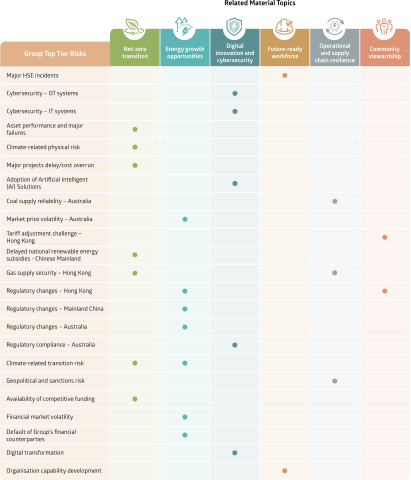
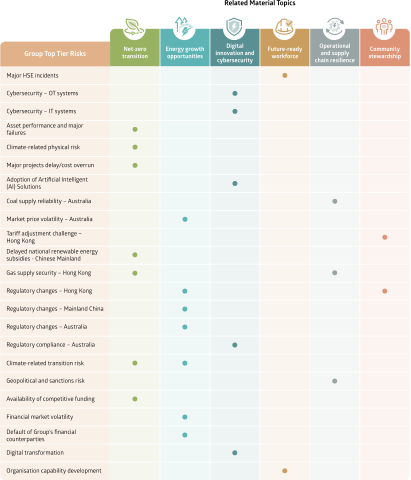
CLP recognises that sustainability and climate-related risks and opportunities are deeply intertwined with its material risks. They are treated as both standalone risks and drivers for other material risks. This approach ensures that CLP’s risk profile remains aligned with its strategic priorities and the sustainability topics most likely to impact the business and its stakeholders. The below table shows the primary material topics associated with each Group top-tier risk.

approach-risk-management-2025approach-risk-management-2025

Back to top

We use cookies for the purpose of enhancing your user experience and helping us better understand how the site is used. By continuing to visit this site, you agree to our Use of Cookies.