CLPʼs nature-related strategy forms an integral part of the environmental aspects of the CLP Group’s 2025-2027 HSE Strategy. It aims to establish a holistic approach to the management of nature-related matters, one that goes beyond mere compliance with existing emissions and other nature-related laws and regulations. In this way, CLP is responding to increasing interest by investors and other stakeholders in how businesses are integrating nature into their corporate strategy.
Copy linkCopied link
CLP’s nature-related strategy has three focus areas, namely biodiversity conservation, Circular Economy (CE) transition and the reduction of environmental discharges. CLP aims at incorporating these critical nature-related matters into its governance, risk management and decision-making processes.
Biodiversity | Biodiversity conservation has a positive impact on ecosystem services, benefitting local economies among other things. By integrating the latest external guidance and findings from ongoing internal assessments, CLP is refining its approach with the aim of achieving the goal of “no net loss of biodiversity” by developing a suitable strategy and roadmap. CLP is currently in the transitional phase of adopting and refining its nature-related frameworks, with a focus on new investment projects, making reference to the sectoral guidance from the TNFD. Read more in the Biodiversity and ecosystem section. | ||||
|---|---|---|---|---|---|
Circular Economy (CE) | CLP is dedicated to driving the transition towards a CE, recognising its ability to address challenges relating to resources and pollution from a life cycle perspective, in steps that are also relevant to climate change and biodiversity conservation. As part of its transitional plan, CLP is engaging and partnering with stakeholders to implement its CE Strategy throughout its operations and value chain. Read more in the Waste management and materials use section. | ||||
| |||||
Reducing Pollution | CLP strives to go beyond compliance with regulatory requirements in minimising its environmental impacts, by the careful management of the air emissions, water use and waste generated during its operations. Read more in the Air emissions, Waste management and material uses and Water sections. | ||||
Following the initial biodiversity sensitive area analysis conducted in 2023, the SEC endorsed the Nature Plan, including the establishment of an internal taskforce, the implementation approach, and the outcomes of pilot nature-related assessments, which adopted an interactive LEAP approach in 2024. These assessments also utilised the widely recognised Integrated Biodiversity Assessment Tool (IBAT) and Exploring Natural Capital Opportunities, Risks and Exposure (ENCORE) tools, and referenced the Roadmaps to Nature Positive by World Business Council for Sustainable Development (WBCSD), where applicable.
In 2025, CLP further advanced its nature-related initiatives for both existing assets and new investment projects, as outlined below.
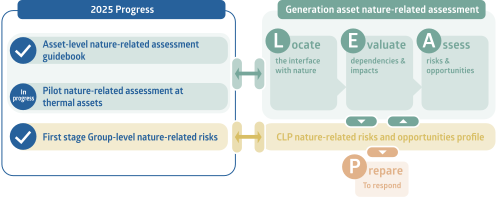
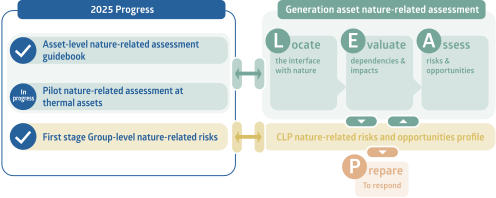
Drawing on experience gained from the first pilot nature-related assessment in 2024, an asset-level guideline for assessing nature-related risks and opportunities was established in 2025. During the year, one thermal generation asset applied this guideline and commenced a further pilot nature-related assessment, adding to CLP’s nature-related risk and opportunity profile.
CLP is also strengthening its approach to identifying the exposure to significant biodiversity risks in its new investment projects, so as to achieve the goal of ‘no net loss of biodiversity’. The scope and level of commitment for this approach are currently being finalised.
The findings from these asset-level nature-related assessments are being consolidated into CLP’s Group-level nature-related risk profile, and the associated risks and opportunities reviewed accordingly. Insights gained from the pilot assessments have also been integrated into the CLP Group 2025-27 HSE Strategy. Finalising the scope and commitment of the applicable investment projects will also support the early identification of potential biodiversity risks.
A full-scale assessment of nature-related dependencies, impacts, risks, and opportunities is more than just a one-off exercise. CLP’s iterative approach forms part of its enduring commitment to nature stewardship, enabling it to prioritise measures that help avoid or mitigate negative impacts and create opportunities for restoring the natural environment. It also supports CLP’s efforts to develop relevant roadmaps for the next stage of its nature-related initiatives.
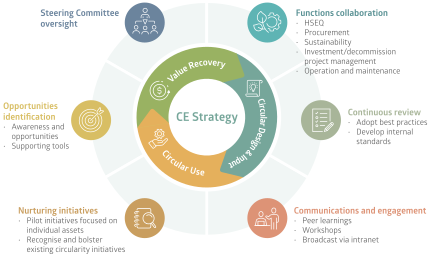
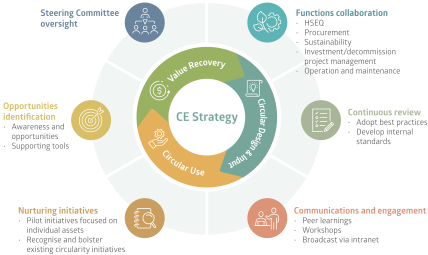
In 2025, CLP furthered its efforts to implement its CE Strategy throughout its operations. In addition to ongoing internal communications via broadcasts and the e-communication platform, CE-related webinars were shared with employees. A series of roadshows were held at major Hong Kong offices to engage employees and enhance their awareness of CE practices. For further information on implementing the CE Strategy in CLP’s sustainable procurement practices, please refer to the Case Study: Advancing circularity in CLP procurement.
As CLP prepares to decommission coal-fired power plants as part of its energy transition, the Company recognises the need to identify CE opportunities in the decommissioning and demolition process. A CE study was kick-started at the end of 2025 to develop an effective approach to identify opportunities to implement the CLPʼs CE Strategy in the process for retiring coal-fired power plants.
For details on CE-related initiatives and programmes in 2025, please refer to the Waste management and materials use section.
These targets have been calibrated to reflect the decline of coal-fired power in CLPʼs asset portfolio, and to reaffirm the Groupʼs commitment to continual improvement in environmental performance, particularly in reducing air emissions, water use and waste generation.
CLP’s comprehensive strategy to reduce air pollution and enhance water and waste management across all aspects of its operations has enabled it to achieve all the environmental targets set for 2025, and meet its medium-term improvement goals. CLP will continue to keep tracking its progress towards its 2030 environmental targets in continual improvement of its environmental performance.
For more information on performance against group environmental targets, please see the Air emissions, Water and Waste management and materials use sections.
We use cookies for the purpose of enhancing your user experience and helping us better understand how the site is used. By continuing to visit this site, you agree to our Use of Cookies.