Back

Approach to materiality assessment

The materiality assessment process is the foundation of CLP’s best practice in sustainability management and reporting, enabling it to integrate sustainability into its business strategy and create long-term value for stakeholders.

Overview of the assessment approach

GRI reference: 2-12, 3-1

CLPʼs materiality assessment helps to contextualise its sustainability-related impacts, risks and opportunities and determine how these should be disclosed in CLP reports. By combining both internal and external stakeholder views with extensive megatrend analysis, CLP identifies the sustainability topics that are most financially material to its business and to stakeholders from an impact perspective.

Global standards for best practice in assessing materiality have continued to evolve in line with broader changes in sustainability disclosure standards.

Most notable are the new standards, HKFRS S1 and HKFRS S2, published by the Hong Kong Institute of Certified Public Accountants (HKICPA) in December 2024, which provide clarity on how to assess financial materiality.

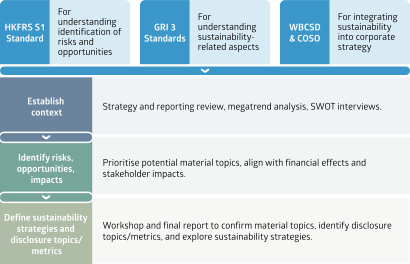
In 2025, CLP considered the best practice advice from standard setters, including the following, amongst others:

ma-process-overview-2025ma-process-overview-2025

Since 2018, CLP has conducted materiality assessments that evaluate how evolving megatrends could impact the sustainability of the Company’s business strategy in the medium to long term.

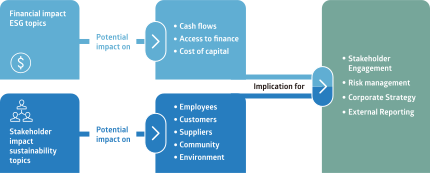
In 2021, CLP embraced the concept of double materiality to support its sustainability risk management and to inform the sustainability-related disclosure of its annual suite of reports.

This approach means that CLP’s Annual Report addresses financially material sustainability topics that could reasonably be expected to affect the Company’s prospects, while the Sustainability Report focuses on sustainability topics that have a material impact on people, the environment and the economy.

Double materiality approach

ma-process-double-ma-2025ma-process-double-ma-2025

The double materiality approach streamlines the disclosures in the Annual Report and Sustainability Report. The material topics and associated CLP responses are summarised in the Materiality Matrix section of this report and the Managing What Matters to Our Business chapter of the Annual Report.

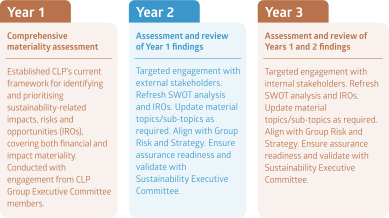
Since 2022, CLP has implemented a three-year double materiality assessment cycle. While CLPʼs methodology has continuously evolved to reflect changes in best practices, the materiality assessment has taken into account topics that are material to the Group in the short, medium and long term. The material topics identified in recent years have remained relatively consistent, with only minor updates over the period. CLP implements the double materiality assessment process based on a three-year cycle.

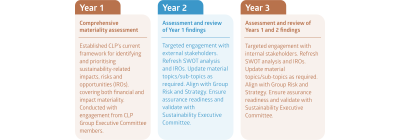
Each year, there are variations in the breadth and scope of the assessment process, with Year 1 involving a comprehensive assessment and Years 2 and 3 focusing on revalidation and the incorporation of incremental changes with reduced time requirements.

CLPʼs three-year double materiality assessment cycle

ma-process-double-ma-three-year-cycle-2025ma-process-double-ma-three-year-cycle-2025

The business value of materiality assessment

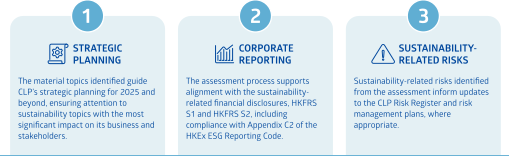
Materiality assessment supports compliance with the sustainability-related financial disclosure standards according to HKFRS S1 and HKFRS S2. In addition to the assessment informing corporate reporting, the process systematically identifies and prioritises the most relevant sustainability topics that require management attention.

The insights gained from the assessment process are instrumental for strategic planning, as they help the organisation to engage stakeholders and anticipate emerging trends. This proactive approach ensures that sustainability is embedded within the broader business strategy, fostering long-term resilience and competitive advantage.

In addition, materiality assessments underpin effective risk management by highlighting areas where environmental, social, or governance factors pose risks or create value. Bringing the material assessment process closer to the risk management process helps CLP to develop targeted responses, allocate resources efficiently and strengthen stakeholder trust.

ma-process-value-of-ma-2025ma-process-value-of-ma-2025

GRI reference: 2-12, 3-1

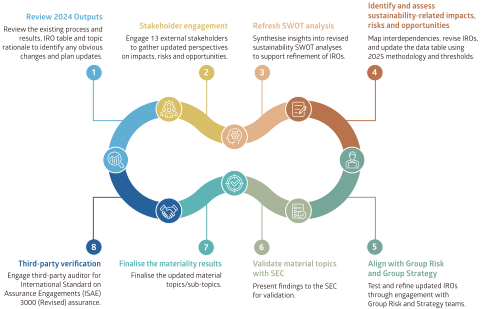
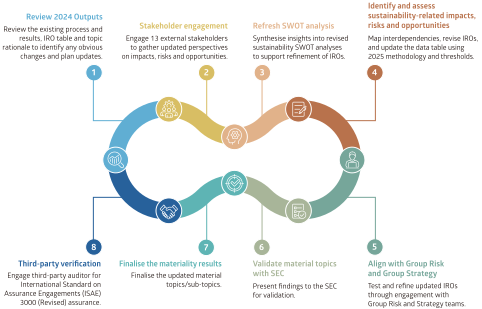
In 2025, CLP undertook the Year 2 assessment approach. The process involves a thorough evaluation of Year 1 findings, with amendments to sustainability priorities made as necessary. Engagement with key stakeholders is undertaken to validate any updates and ensure the continued relevance of the assessment.

Engage stakeholders

Review the existing process and results, IRO table and topic rationale to identify any obvious changes and plan updates. CLP engaged a diverse group of stakeholders including investors, industry experts, regulators and customers. They evaluated the megatrends most relevant to CLP’s outlook, and SWOT analysis were conducted. In addition, risk registers, strategy paper, company policies, and international reporting standards were examined in order to help it identify impacts, risk and opportunities conceivably material to CLP’s current and future prospects.

Identify, assess and validate impacts, risks and opportunities

To identify sustainability-related impacts, risks and opportunities (IROs), CLP undertook interviews to collate the views of a broad range of internal stakeholders from CLP’s middle and senior management, a review on megatrends to reflect CLP’s current operating context and a review of the latest reporting standards. It identified a total of 93 IROs and grouped them under the nine megatrends most likely to affect CLP’s business and operating environment.

ma-process-identify-assess-validate-2025ma-process-identify-assess-validate-2025

CLP continued to apply the assessment methodology by considering the severity and likelihood of risk and the benefit magnitude and likelihood of opportunities. Each impact, risk and opportunity was assessed as either negative or positive, actual or potential (based on the latest GRI 3: Material Topics 2021 guidance). In 2025, CLP continued to assess with considerations such as time horizon (short-term, medium-term and long-term) and position in the value chain (upstream, own operation and downstream) consistent with the IFRS S1 standard. The time horizon is specified over which the effects of each of those sustainability-related risks ad opportunities could reasonably be expected to occur. This should link to the planning horizons used for strategic decision-making.

Time Horizon

Duration

Description

Short-term

0-1 year

Reflecting the effects in current reporting year and in line with that adopted by the Group in the consolidated financial statements

Medium-term

1-5 years

Aligning business planning and budgeting, which are typically structured over five years. This timeframe also supports regular mid-term reviews of Scheme of Control and reflects standard accounting practices, ensuring consistency and strategic responsiveness across financial and operational planning.

Long-term

More than 5 years

Reflecting changes in climate pattern and evolving megatrend

To finalise the assessment phase, the significance of each negative impact or financial risk was evaluated for its severity and likelihood. The methodology incorporated the latest GRI Standards, the ISO 31000 Risk Management Standard and CLP’s existing Group Risk Management Framework. A similar methodology was devised to assess the significance of each positive impact and financial opportunity, considering the benefit magnitude and likelihood of each opportunity.

After evaluating for magnitude/severity and likelihood, 57 IROs were assessed as ‘High’ or ‘Extreme’ and therefore material. Of these, 35 were sustainability-related financial risks (25) and opportunities (10) and 22 were stakeholder impacts (11 positive, 11 negative). The prioritised sustainability-related impacts, risks and opportunities have been summarised in CLP’s Sustainability Report and Annual Report respectively.

Assurance and validation

The assessment outcomes have been thoroughly refined and validated by CLP Holding’s Sustainability Executive Committee, and subsequently endorsed by the Sustainability Committee. As an industry pioneer, CLP has engaged a non-financial auditor to provide limited assurance on its materiality assessment, in accordance with the International Standard on Assurance Engagements (ISAE) 3000 (Revised): Assurance Engagements Other Than Audits or Reviews of Historical Financial Information. This initiative underscores CLP’s ongoing commitment to transparency and accountability within its materiality assessment, while also reinforcing the integrity and credibility of its sustainability reporting.


Back to top

We use cookies for the purpose of enhancing your user experience and helping us better understand how the site is used. By continuing to visit this site, you agree to our Use of Cookies.