Copy linkCopied link
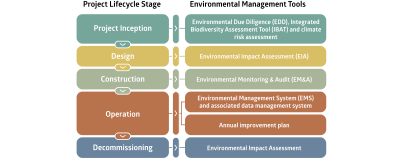
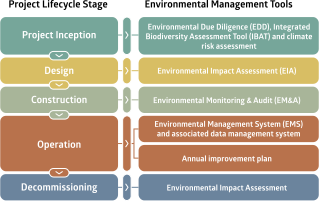
To effectively manage and build resilience on nature-related impacts, risks and performance, CLP utilises a series of environmental management tools and processes to ensure that nature-related matters are properly managed at each stage of the project life cycle. For details, please refer to the Project cycle framework for environmental management and assessment section.
The following sections describe how CLP manages individual nature-related matters that are considered material, with respect to the focus areas of its nature-related strategy. CLP has goals and targets that go beyond regulatory compliance requirements to drive continual improvement, together with performance indicators that monitor the progress and effectiveness of its nature-related strategies, plans and programmes.
To strengthen the management of nature-related matters in the HSEMS, CLP carried out a review of relevant nature-related frameworks (including those aligned with the TNFD) and of its own nature-related practices.
At the project inception stage, CLP conducts a Pre-investment Environmental Risk Assessment (which includes EDD) to identify potential nature-related risks, liabilities and impacts of the project. The Integrated Biodiversity Assessment Tool (IBAT) and the Climate Risk Assessment Tool are also used to respectively screen biodiversity-sensitive areas and identify potential climate-related risks to which the proposed project may be exposed. These due diligence processes enable the early evaluation of any operational and business risks associated with the proposed project. They are followed by further analysis and stakeholder engagement exercises to mitigate the risks where appropriate.
The EIA is a crucial step in ensuring all relevant environmental impacts (such as impacts on air quality, water quality and biodiversity) have been properly considered and, where applicable, addressed by effective mitigation measures. CLP has processes in place to fulfil the EIA requirements and recommendations stipulated by local regulators and follows these same requirements in countries where regulations are not as stringent.
Over the years, CLP has diligently managed its environmental impacts in line with international best practices. For example, under the HSEMS, all power generation assets of which CLP has operational or joint operational control are required to achieve third-party certification to international ISO 14001:2015 Environmental Management Systems standard within two years from the commencement of operation or acquisition. In 2025, all assets in this category had successfully certified their EMS to the ISO 14001: 2015 standard.
CLP deploys digital technology for environmental data management to ensure data integrity and to measure progress against targets, as well as to facilitate follow-up actions for each asset. CLP has been implementing customised environmental data management systems, called "EMIS" in Hong Kong and "MonitorPro" in Australia. These tools are designed to safeguard environmental data, automate trend analysis and data reporting and support compliance and risk management.
For details of how these environmental management tools and processes are being applied to specific environmental areas, please refer to the Biodiversity and ecosystem, Air emissions, Waste management and materials use, Water and Energy conservation.
Copy linkCopied link
CLP seeks to adapt and mitigate its impacts on biodiversity and ecosystems of significance in the vicinity of its operations as part of its goal of “no net loss of biodiversity”. CLPʼs approach is grounded in regulatory biodiversity controls. It also implements site-specific initiatives and, where necessary, initiates ecological compensation programmes.
In 2024, the EDD process was updated to incorporate more nature-related elements, which included the adoption of IBAT (Integrated Biodiversity Assessment Tool) for identifying biodiversity sensitive areas. IBAT contains a database of global biodiversity-sensitive areas and threatened species, and is used during the pre-investment stage to avoid biodiversity risks. This tool enables CLP to identify potential biodiversity risks early, allowing for due diligence and early evaluation of operational and business risks. Further analysis and stakeholder engagement exercises follow to mitigate these risks if appropriate.
The CLP Biodiversity Impact Assessment Guideline applies to power generation, transmission and distribution, mines and other power-related projects. It provides a framework for systematically assessing biodiversity impacts and managing biodiversity risks. For example, the Guideline helps CLP flag new operations that could affect the IUCN Red List of Threatened Species and the relevant country’s national conservation list of threatened species well ahead of any investment decision. The Guideline is currently being updated to include considerations from sectoral guidelines issued by the TNFD.
The biodiversity impact assessment also observes local legislative requirements and references the International Finance Corporation Sustainability Framework. It involves describing the baseline conditions, evaluating the magnitude and significance of project impacts and investigating options for mitigation. The assessment only contemplates offsets after considering options for avoidance, minimisation and restoration or rehabilitation.
Mitigation measures will be developed based on the findings and on recommendations from the EDD and Environmental Impact Assessment (EIA) exercises, to address adverse impacts related to nature, biodiversity and ecosystems.
At the project operation stage, all identified adverse impacts will be monitored and controlled under the EMS. The EMS is also continuously reviewed to incorporate emerging environmental matters, such as nature, into existing management processes.
The biodiversity and nature-related enhancement programmes undertaken in 2025 include:
Copy linkCopied link
While expanding its renewable and nuclear energy portfolio, CLP has also been striving to reduce air emissions from its operations. Achieving further emission reductions from existing fossil fuel power stations remains a high priority.
According to the CLP Group HSEMS, the coal-fired and gas-fired power plants under CLPʼs operational control must adhere to CLP’s prescribed limits on SO2, NOx and total PM, or they must fully comply with local regulations, whichever is more stringent. These emissions are monitored by continuous emissions monitoring systems. Aware of the increasing focus on mercury emissions from coal-fired power plants, CLP has also been monitoring and reporting mercury quantities from its coal-fired power plants since 2021.
In addition to incorporating state-of-the-art air emissions control technologies and mitigation measures into its plant management, CLP has also designed new gas-fired power stations with advanced generation technologies. These new technologies enhance electricity generation efficiency, and are contributing to the further reduction in air pollutants and greenhouse gas emissions.
Coal-fired power plants, such as Yallourn, Mount Piper and Castle Peak Power Stations, are the main contributors to the Groupʼs air emissions, and its emissions metrics are largely influenced by these plants’ performances. CLP uses a combination of a carefully managed fuel mix and advanced technologies to limit its air emissions.
CLP has set Group-wide medium- and long-term emissions targets for the years 2025 and 2030 to guide further improvements in reducing air emissions of NOx, SO2 and particulate matters (PM). The emission targets scope covers all power plants under CLP’s operational control.
The 2025 results related to the air emissions targets and progress are shown in the following table:
Nature metrics | Pollution Reduction | Target Range | Target | 2025 Results | 2025 Progress |
|---|---|---|---|---|---|
Air emissions (Impact driver) | NOx emissions | -20% to -30% | -50% | -35% | Achieved |
SO2 emissions | -15% to -20% | -55% | -19% | Achieved | |
PM emissions | -10% to -15% | -90% | -28% | Achieved |
In 2025, CLP achieved all three air emissions targets through multiple efforts in the past few years. This was partly due to the divestment of the coal-fired Fangchenggeng Power Station on the Chinese Mainland and the exclusion of assets in India, notably the coal-fired Jhajjar Power Station, since Apraava Energy has ceased to be a subsidiary and is now accounted for as a joint venture. CLP further reduced emissions through its fuel diversification strategy and effective air emission controls. Compared to the baseline year of 2021, emissions of NOx, SO2 and PM were reduced by 35%, 19%, and 28% respectively in 2025.
Key initiatives and programmes in 2025 included:
Compared to 2024, Group-level air emissions of NOx, SO2 and total PM in 2025 decreased, mainly due to lower utilisation of the coal-fired Castle Peak, Mount Piper and Yallourn Power Stations.
Copy linkCopied link
CLP is striving to implement its Circular Economy (CE) Strategy across its project lifecycles, exploring opportunities for minimising materials use and waste disposal, further to following a waste management hierarchy (i.e. avoid, reduce, reuse, replace, recycle, treat and dispose) to prioritise preferred actions for minimising waste generation in its daily operations.
Through the EDD and EIA during the project design and construction stage and the EMS during the operation stage, all hazardous and non-hazardous waste is managed appropriately and in accordance with local regulations. Following the waste reduction hierarchy, CLP prioritises waste reduction and then reuse and recycling rather than disposal. CLP also encourages the adoption of CE principles throughout the project cycle, from design to end-of-life. If hazardous waste has to be collected for recycling or disposal, it is handled by licensed contractors in accordance with local regulatory requirements.
The main operational by-products of CLP’s coal-fired power stations are coal ash from coal combustion and gypsum from the flue gas desulphurisation process. CLP actively manages these by-products according to the waste management processes and procedures outlined in the EMS. Rather than disposing of them, CLP endeavours to reuse them for construction and other applications in line with circular economy principles and in accordance with local regulations and practices.
While CLP’s regular operations produce relatively small amounts of solid and liquid waste, projects involving demolition and construction usually increase the generation of non-hazardous solid waste. These waste streams are addressed and monitored under the EMS, and incorporate CE concepts to minimise waste and pollution. CLP also collaborates with its suppliers in identifying recovery and recycling opportunities, and works to drive behavioural changes among its own employees. This includes setting up recycling facilities at power stations and office premises, and providing e-learning courses on circular economy principles and waste management.
CLP monitors waste generation on a monthly basis by tracking the solid and liquid forms of hazardous and non-hazardous waste produced and recycled at its facilities.
Reviews of all the ash impoundments at CLP-owned plants (i.e. the various ash lagoons at Castle Peak Power Station in Hong Kong and Yallourn Power Station in Australia) have identified them as having low hazard potential and satisfactory structural integrity.
Various measures and initiatives have been implemented to minimise waste and promote the reuse and recycling of materials during electricity generation and other operations. CLP recycles both hazardous and non-hazardous waste and sells or recycles by-products, such as ash and gypsum, for reuse in other industries where feasible.
Different assets generate varying types of waste, with fossil fuel plants being the main contributors. The amount of waste produced and recycled is not directly linked to the amount of electricity sent out, but it can be affected by maintenance and construction activities, as well as local waste facilities and treatment practices.
CLP has set Group-wide medium- and long-term waste targets for the years 2025 and 2030 in terms of a percentage reduction of total waste produced, including by-products produced by its coal-fired power plants, against the base year of 2021. Waste targets for 2025 also include recycling of 100% of Waste Electrical & Electronic Equipment (WEEE), scrap rechargeable batteries, scrap metals and inert construction waste, and eliminating single-use plastics in catering facilities. The waste target scope covers all assets under CLP’s operational control.
In 2025, CLP achieved all its waste management targets, including those for 100% recycling. Compared to 2021, total waste from operations was reduced by 74%, due to the implementation of waste management initiatives, the divestment of the coal-fired Fangchenggeng Power Station on the Chinese Mainland, and the exclusion of assets in India, notably the coal-fired Jhajjar Power Station, since Apraava Energy has ceased to be a subsidiary and is now accounted for as a joint venture.
The 2025 results relating to the waste targets and their progress are shown in the following table:
Nature metrics | Pollution Reduction | Target | Target | 2025 Results | 2025 Progress |
|---|---|---|---|---|---|
Waste (Impact driver) | Waste products1 | -65% | -70% | -74% | Achieved |
Recycling of Waste Electrical & Electronic Equipment (WEEE) | 100% | -- | 100% | Achieved | |
Recycling of rechargeable batteries | 100% | -- | 100% | Achieved | |
Recycling of scrap metal | 100% | -- | 100% | Achieved | |
Recycling of inert construction waste | 100% | -- | 100% | Achieved | |
Removal of single-use plastics in catering facilities | 100% | -- | 100% | Achieved |
Key programmes and initiatives in 2025 are outlined below. Each of the following icons indicates that each initiative is relevant to which pillar of the CLPʼs CE Strategy adopted, as described in the Framework for implementing the Circular Economy Strategy in operations section.
The total amount of ash and gypsum by-products recycled or sold in 2025 decreased compared to 2024. This decline was due to reduced generation from the coal-fired Castle Peak and Mount Piper Power Stations. For gypsum, Castle Peak B Power Station remains the sole contributor.
The total amount of hazardous waste produced in 2025 increased compared to 2024, mainly due to Castle Peak Power Stationʼs special project involving asbestos ash pipeline demolition and oil interceptor cleaning work. Recycling amounts increased slightly because the hazardous liquid generated from the oil interceptor cleaning work could be fully recycled.
The total amount of non-hazardous waste produced in 2025 increased compared to 2024, mainly due to a construction project at Black Point Power Station and outage maintenance work undertaken at Castle Peak and Mount Piper Power Stations. Recycling amounts increased in 2025 compared to 2024, primarily due to the recycling of inert construction waste from the construction project at Black Point Power Station.
Copy linkCopied link
CLP has been strengthening its water management practices to reduce water usage and wastewater discharge, for example by using seawater cooling and water recirculation processes in its generation plants.
CLP is working to reduce the amount of fresh water it uses for its operations, and to minimise the impact of new energy projects on water systems. CLP’s power stations carry out a range of water conservation initiatives depending on their site conditions, operational situation and age. The amount of water which can be recycled also depends on factors such as location, power station design and local regulatory requirements.
There are two major water concerns that affect CLP. One is that water use in its power plants may impact local water quality and contribute to local water scarcity. To address this, EIAs are carried out at the planning stage of new projects, in accordance with local requirements, to ensure that any water use impacts associated with project construction and plant operation are managed and mitigated to an acceptable level.
The second concern is water security at CLP’s fossil fuel and hydropower generation assets. Four of CLPʼs six fossil fuel plants under operational control use seawater for cooling. Where seawater cooling is not feasible, CLP strives to minimise its use of freshwater and instead adopt water recirculation processes. Solar farms also use water for the cleaning of solar panels, but the amount required is comparatively small. These measures help limit the risks caused by water security issues.
CLP assesses water risks associated with its new projects through systematic environmental due diligence and using globally recognised tools such as WRI Aqueduct. Its assessments cover parameters such as water availability, water sensitivity, water stress mapping, potential competing use with other stakeholders and the management strategies in each region. Where a water supply risk is identified, the Company engages with local stakeholders to understand their needs and with local water suppliers to mitigate or resolve the issue. The latest assessments across the Group indicate that its current water supply regimes are stable and the overall risk of substantial impact is minimal.
The quality of CLP’s water discharges must also meet licensing and regulatory standards. Under CLP’s EMS, the adverse impacts of water discharges are identified, monitored and controlled under programmes which are reviewed on a regular basis. Specific emergency response plans have also been developed to prevent and address the spillage or leakage of pollutants. As a result of the wastewater treatment processes put in place, none of CLPʼs operations had any material impact on the water bodies associated with them.
To monitor its water-use efficiency, CLP tracks its freshwater withdrawal, discharge and intensity (based on electricity sent out). Internal targets are set each year to encourage continuous improvement in water management practices. CLP also participates in the CDP water security questionnaire. By sharing water resource management data through the survey, CLP is able to benchmark its practices against industry peers.
In 2023, CLP reviewed its environmental target-setting process and refined its water targets to reflect the upcoming retirement of its fossil fuel plants. CLP has set Group-wide medium- and long-term freshwater consumption targets for the years 2025 and 2030 in terms of a percentage reduction of freshwater and municipal water consumption quantities against the base year of 2021. It set an ambitious freshwater consumption target comprising an absolute reduction of 45% to 55% by 2025, and a reduction of 85% by 2030, using 2021 as the baseline. The freshwater consumption target scope covers all CLP’s operationally controlled assets.
The 2025 results against the Group-wide medium- and long-term freshwater consumption targets are shown in the following table:
Nature metrics | Pollution Reduction | Target Range by end 2025 | Target by end 2030 | 2025 Results | 2025 Progress |
|---|---|---|---|---|---|
Water (Dependencies) | Freshwater and municipal water consumption | -45 to -55% | -85% | -55% | Achieved |
CLP achieved its 2025 freshwater consumption target due to the implementation of water conservation initiatives at certain assets, the divestment of the Fangchenggeng coal-fired Power Station on the Chinese Mainland, and the exclusion of assets in India, notably the coal-fired Jhajjar Power Station, since Apraava Energy has ceased to be a subsidiary and is now accounted for as a joint venture. As a result, CLP achieved an 55% reduction in freshwater and municipal water consumption in 2025 compared to the 2021 baseline year.
CLP will continue to track the volume of water recycling in its power stations for continual improvement, as well as share good practices across the Group to maximise the benefit of individual power stationsʼ efforts.
Best practice examples of CLP’s water management are summarised below:
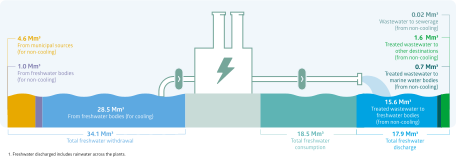
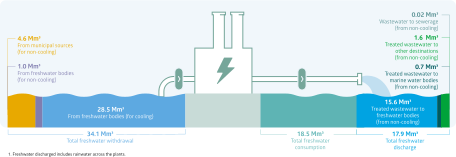
Total freshwater consumption of CLP Groupʼs power generation, as well as total freshwater consumption in water-stressed areas, decreased in 2025 compared to 2024. This was mainly due to reduced freshwater usage at Yallourn Power Station, resulting from an increase in treated wastewater being discharged to the same freshwater body from which freshwater is withdrawn.
Copy linkCopied link
CLP is dedicated to energy conservation by optimising operational energy efficiency, advancing the transition to low-carbon and renewable resources, and providing energy efficiency and conservation solutions to customers. Under the Group’s Health, Safety and Environment (HSE) Policy, efficient energy use forms part of CLP’s commitment to responsible resource management and environmental stewardship.
In addition to a variety of electricity efficiency and conservation measures, CLP also promotes energy-saving behaviours among its employees. CLP will continue to look for energy conservation opportunities and initiatives through energy audits and various energy conservation programmes across its operations. Key initiatives and programmes for 2025 are highlighted below.
For details on fuel consumption for power generation and energy sent out based on renewable resources, please refer to the Asset management section. For details on how CLP supports customers in improving energy efficiency, please refer to the Energy services and solutions section.